 Smart Cards
Short answer: for a company, the best NFC business card is the one your company controls. Look for central branding, editable profiles, per-team field locks, a way to switch off a leaver's card, one shared lead list and a price that does not climb with every new hire. The plastic is the easy part.
Search "best NFC business cards" and most results compare metal finishes and chip types. That is useful if you are buying one card for yourself. If you are buying for a sales team of twelve or a company of two hundred, the questions change. You are no longer choosing a card. You are choosing how your company's contact details will be managed for the next few years.
This guide covers what an operations, HR or marketing lead in the UAE should check before ordering NFC business cards for a team, and why.
How NFC business cards work, in one paragraph
An NFC business card has a small chip inside a printed PVC (or metal, or wood) card. When someone holds it near a phone, the phone opens a link stored on the chip. That link points to the cardholder's digital profile: name, title, phone, WhatsApp, email, website, social links and a button to save the contact. The profile lives online, so it can be edited without reprinting the card. A QR code on the card does the same job for phones that do not read NFC.
The 9 things that matter when a company buys NFC cards
1. The receiver needs no app
If the person you meet has to install something, the card has failed. Modern iPhones and Android phones read NFC natively and open the profile in the browser. Check that the supplier's profile page loads quickly on mobile data and has a clear Save Contact button that adds a proper contact card (vCard) to the phone's address book.
2. Your branding, not the supplier's
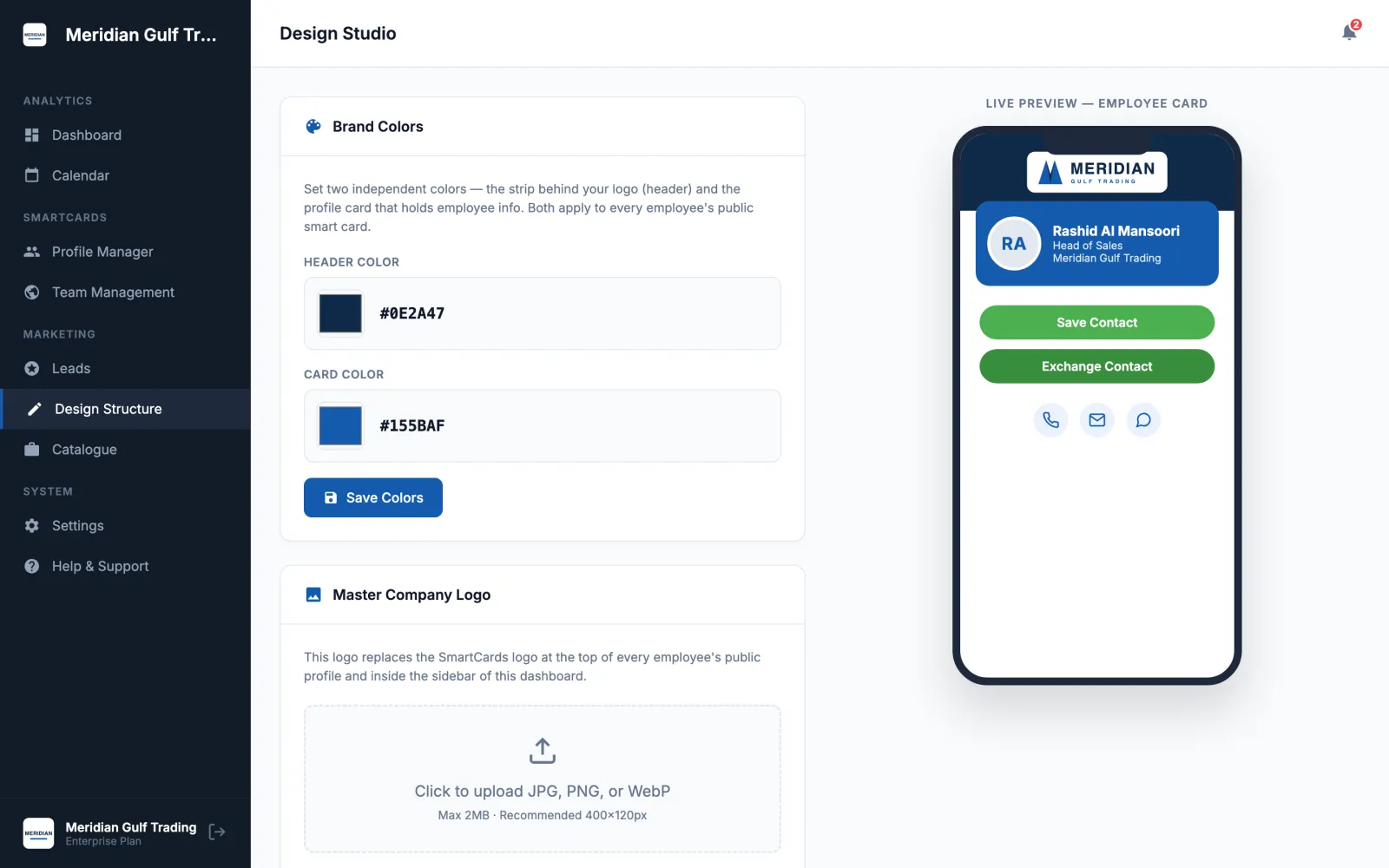
Many platforms put their own logo at the top of every profile. For a company, that is free advertising for someone else on every handshake. Ask whether you can replace it with your logo and set your own colours across all employee profiles at once. This is usually what "white-label digital business cards" means in practice.
3. Central control without taking over people's cards
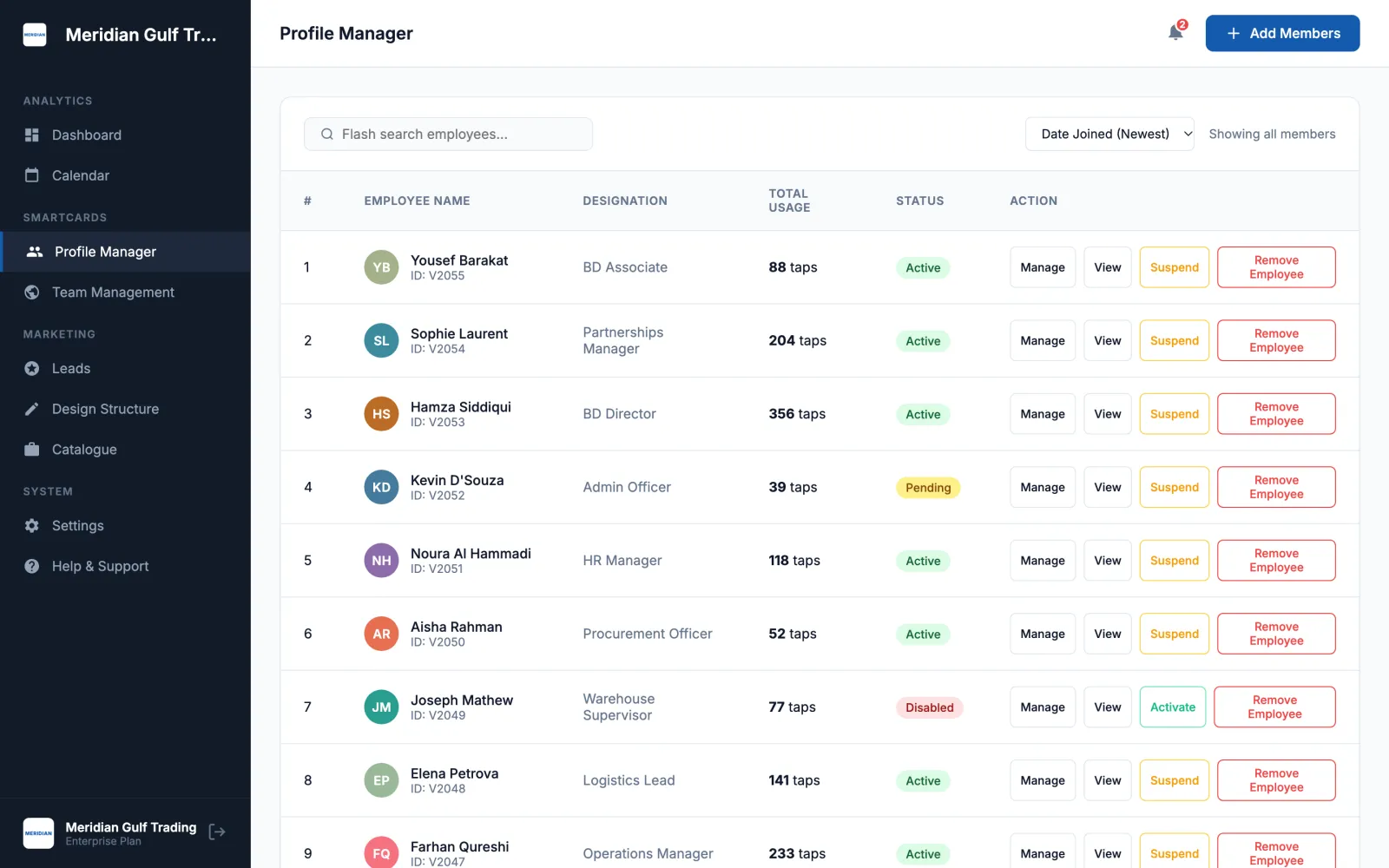
The company should be able to see every employee's card in one list, fix a typo in someone's title, and see who has not finished their profile. At the same time, staff should still be able to update things that are theirs, like a profile photo. The balance between those two is the next point.
4. Field locks, so titles stay as HR approved them
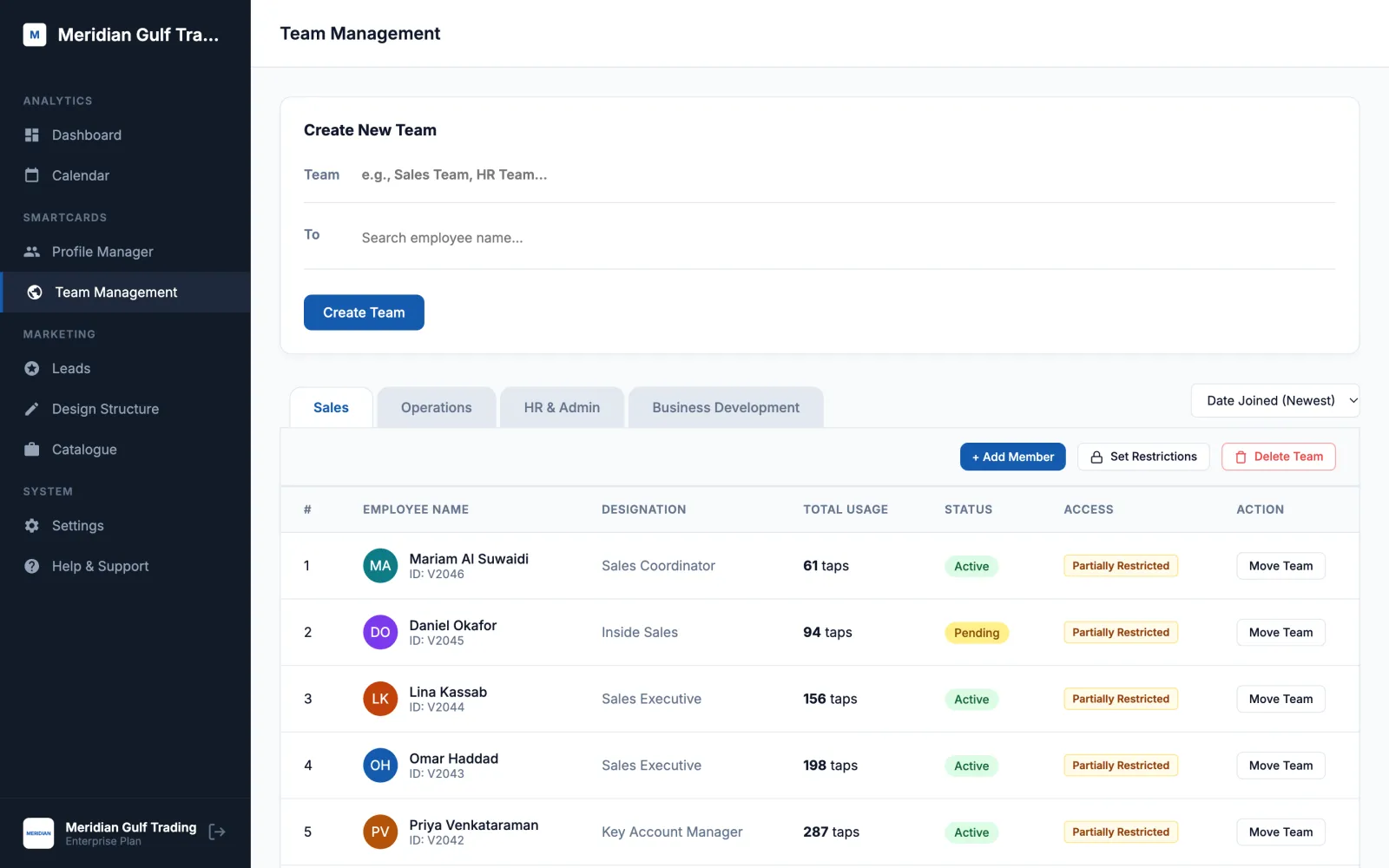
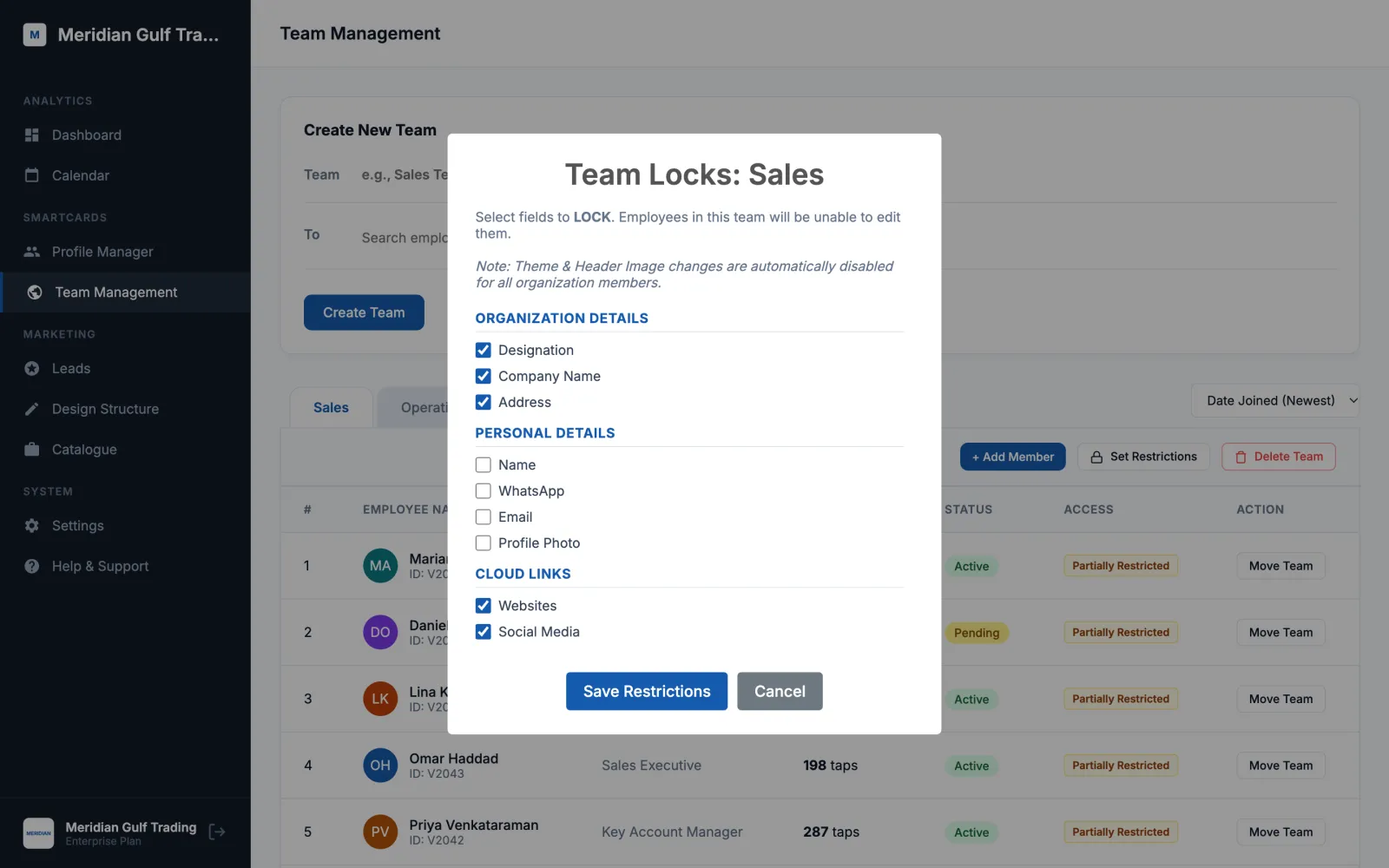
Left alone, a team's cards drift. One person writes "Sr. Sales Exec", another "Senior Sales Executive", a third adds a personal Instagram. Good company platforms let you lock specific fields per team, for example designation, company name, address and website, while leaving others editable.
5. A clean exit when someone leaves
This is the question most buyers forget, and the one that matters most. A paper card from a former employee keeps circulating, but at least it does not update. An unmanaged NFC card is worse: it keeps sending prospects to a live profile of someone who no longer works for you. Ask what happens on day one after a resignation. The right answer is that an admin can suspend the card so anyone tapping it sees a suspended notice, and can release the person's profile from the company without deleting it.
6. Lead capture that the company can see
A digital profile can do something paper never could: collect the other person's details. Look for a two-way exchange contact feature, where the prospect shares their name, phone, WhatsApp and email back. Then ask the important follow-up: does the company see those leads, or only the employee? For sales teams, an organization-wide lead list with a CSV export is the feature that pays for the whole system.
7. A product or service catalogue on the card
If your team sells, the card can do more than share a phone number. Some platforms let the company add products or services with an image, price and link, and show them on employee cards as items staff cannot edit. That keeps pricing and descriptions consistent across the team.
8. Pricing that does not punish growth
Most corporate digital business card platforms charge per user per month. That looks small for five people and becomes a real line item at fifty. Work out the cost at your expected headcount in two years, not today. Flat per-organization pricing is easier to budget.
9. Local printing and delivery
For a UAE company, a card printed and programmed locally means faster turnaround for new joiners and no customs delays. Ask who prints the card, whether both sides carry your design, and how long a single replacement card takes to arrive.
Paper, individual NFC cards and a managed platform, compared
| What a company needs | Paper cards | Individual NFC cards | Managed NFC platform |
|---|---|---|---|
| Change details after printing | Reprint | Each person edits their own | Employee or admin, live on every card |
| Company branding enforced | At print time only | Varies card to card | Applied to all profiles centrally |
| Consistent job titles | Only if HR checks the proof | No | Field locks per team |
| Leaver's card | Stays in circulation | Stays live, owned by the employee | Suspended by an admin |
| Leads from the team | None | Only the cardholder sees them | One company list, exportable |
| Cost as you hire | Every reprint, every person | Per card | Per card, plus the platform fee |
Questions to ask any NFC card supplier
- Can I replace your logo with ours on every employee profile?
- Can I lock job titles and company details so staff cannot change them?
- What does someone see when they tap a former employee's card?
- Do I see the contacts my team collects, and can I export them?
- Is the software priced per user or per company?
- Where are cards printed, and how fast is a single replacement?
- Can I add twenty people at once, or is it one by one?
Where Smart Cards UAE fits
We built the Smart Cards organization portal around the checklist above. Cards are white PVC printed with your design on both sides by PrintOnline.ae in the UAE, with an NFC chip and a QR code. The portal lets a company:
- invite employees in bulk by card ID or email, with each person accepting the invitation;
- apply its logo and two brand colours to every employee's public profile;
- group people into teams and lock fields per team;
- suspend a card in one click, or remove someone so they keep a personal profile without company branding;
- see every contact exchanged with any employee, filter by team or person, and export a CSV;
- publish company products and services to employee cards.
The portal costs a flat AED 50 per month, or AED 500 per year, per organization, with no per-seat fee. Cards are a one-time purchase each.
Frequently asked questions
What is the best NFC business card for a company?
The best NFC business card for a company is one where the company, not each employee, controls the profiles behind the cards: central branding, fields that can be locked, a way to switch off a leaver's card, and one place to see every lead. The physical card matters less than the platform managing it.
Do NFC business cards work with iPhone?
Yes. iPhone XS and later read NFC tags in the background, and most Android phones with NFC switched on do the same. A QR code printed on the card covers older phones and phones with NFC turned off.
How much do NFC business cards cost for a team in the UAE?
Expect two costs: the printed card, paid once per employee, and the management software. Some platforms charge the software per user per month. Smart Cards UAE charges a flat AED 50 per month, or AED 500 per year, per organization regardless of headcount.
What happens to an NFC business card when an employee leaves?
With an individual card, nothing: it keeps sharing the old details. With a company-managed platform, the admin suspends the profile and anyone who taps the card sees a suspended notice instead of outdated contact details.